Speak with a licensed insurance agent

1-888-891-0229

Cancer Insurance: How It Works, What It Pays and Who Needs It

Updated October 2026

Key Takeaway

Cancer insurance is a supplemental policy that pays you cash after a covered cancer diagnosis. It does not replace your health plan. It fills the gap between what your health plan pays and what a diagnosis actually costs your household.

A cancer diagnosis brings two sets of bills. The first comes from doctors and hospitals, and your health plan pays most of it after you meet your deductible and coinsurance. The second never shows up on a medical statement: the paychecks you miss, the gas and hotel nights for treatment out of town, the child care and the bills that keep coming while you recover.

Cancer insurance is built for both. This guide explains how a policy works from the day you apply to the day a claim is paid, which policy terms matter most, and how to decide how much coverage you need. When you are ready to shop, you can compare cancer insurance plans from several insurance companies side by side.

See Cancer Insurance Plans in Your Area

Speak with a licensed insurance agent

1-888-891-0229

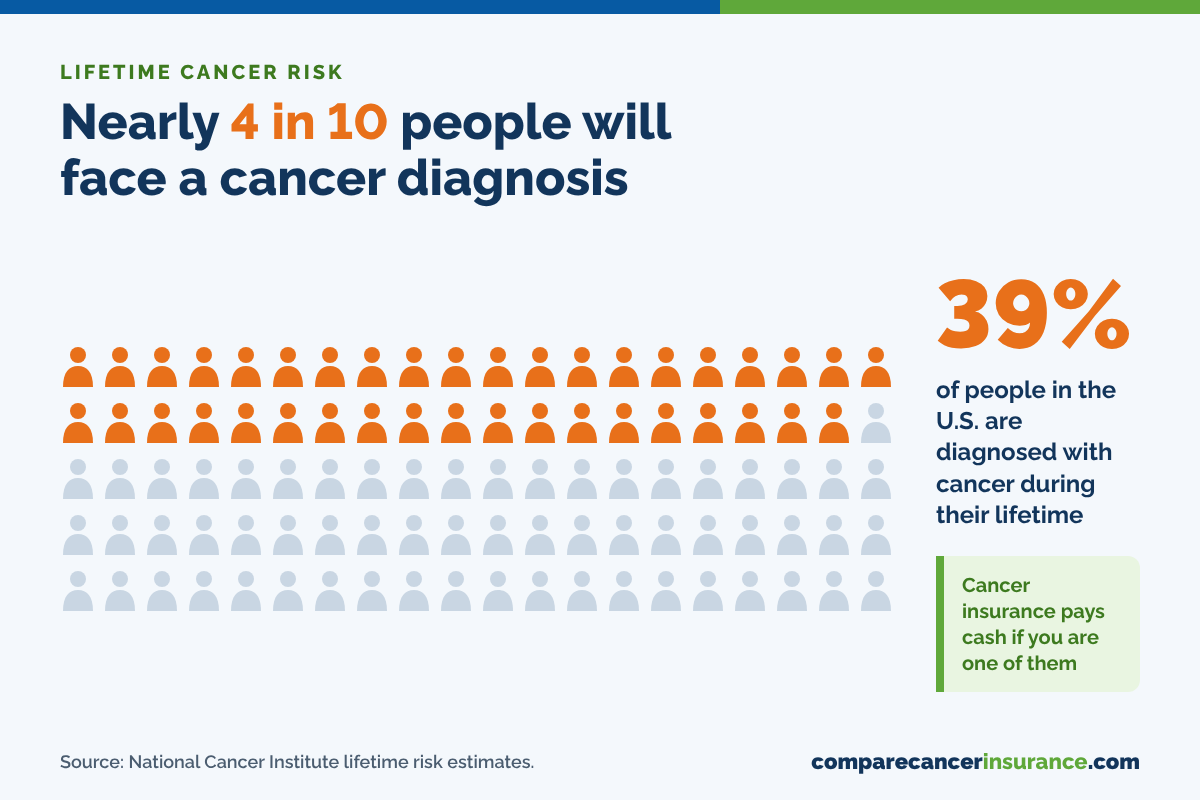
Nearly 4 in 10 people in the U.S. will be diagnosed with cancer in their lifetime, according to the National Cancer Institute

Why a Cancer Diagnosis Costs More Than Your Health Plan Covers

The National Cancer Institute estimates that nearly 4 in 10 people in the United States will be diagnosed with cancer at some point in their lives, and the American Cancer Society projects roughly 2 million new cases each year. Treatment is better than ever, but it often lasts months and can involve several specialists and facilities.

Even with good health coverage, a household can face costs in three places:

Plan Cost-Sharing

Deductibles, coinsurance and copays until you reach your plan’s out-of-pocket maximum, which can reset each January in the middle of treatment.

Costs Health Plans Skip

Travel, parking, lodging near a cancer center, meals away from home and help around the house.

Lost Income

Time off for treatment and recovery, for you or for a spouse or family member who becomes your caregiver.

Why cash matters

Because cancer insurance pays you instead of your doctors, you decide where the money goes, whether that is a hospital bill, a mortgage payment or a plane ticket to a specialist.

How Cancer Insurance Works, Step by Step

Every policy has its own details, but the path from application to payment follows the same pattern:

1You apply while healthy. Most individual policies ask a short set of health questions and do not require a medical exam.
2The insurer approves your policy. You choose a benefit amount and any riders, and your premium is set.
3The waiting period passes. Most policies do not cover a cancer diagnosed in the first 30 days or so of coverage.
4A covered cancer is diagnosed. Your doctor confirms the diagnosis, usually with a pathology report.
5You file a claim. You send the claim form and medical records to the insurance company.
6The insurer pays you. The benefit goes to you, or to someone you name, to use however you choose.

Most policies are guaranteed renewable, which means the insurer cannot cancel your coverage because your health changes, as long as you keep paying the premium.

Get a Free Cancer Insurance Quote

Speak with a licensed insurance agent

1-888-891-0229

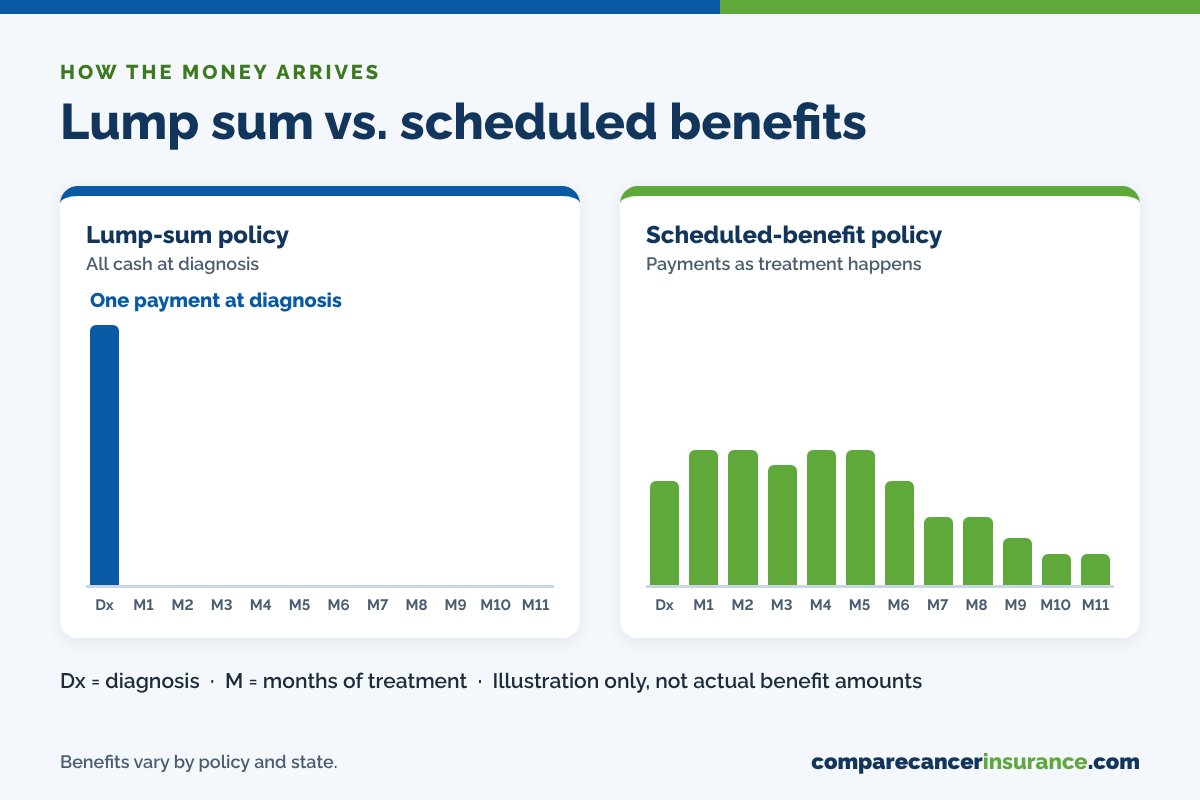
How cancer insurance pays: a lump-sum policy pays once at diagnosis, while a scheduled-benefit policy pays as treatment happens

Lump-Sum vs. Scheduled-Benefit Cancer Insurance

The biggest choice you will make is how the policy pays. Here is how the two main designs compare:

Lump-Sum PolicyScheduled-Benefit Policy
How it paysOne cash payment when a covered cancer is first diagnosedSet amounts each time you receive a covered treatment
Best forFlexibility and fast access to cashLong or complex treatment with many sessions
Typical benefitA fixed amount you choose, such as $10,000 or $50,000Per-treatment amounts, such as a set payment per month of chemotherapy or per hospital day
PaperworkUsually one claim with proof of diagnosisOngoing claims as treatment continues
Watch forA reduced benefit for early-stage or in situ cancer on some policiesLifetime maximums on certain benefits

Some insurers combine both designs in one policy. Benefits and limits vary by carrier and state.

A lump-sum policy is simpler and puts money in your hands quickly. A scheduled-benefit policy can pay more in total over a long treatment, but only as treatment happens. Many people pair a modest lump sum with a hospital or treatment rider to get some of both.

Policy Terms You Should Understand Before You Buy

Cancer policies use a handful of terms that make a big difference when it is time to file a claim:

Waiting Period

The time after your policy starts before a new diagnosis is covered, commonly about 30 days.

Look-Back Period

How far back the insurer checks for a prior cancer, often 5 to 10 years.

Carcinoma in Situ

Cancer that has not spread. Some policies pay a reduced amount; others pay in full.

Recurrence Benefit

A payment if cancer returns after a treatment-free period, often sold as a rider.

Covered Cancer Definition

Which cancers qualify. Many policies exclude most skin cancers other than melanoma.

Guaranteed Renewable

The insurer cannot cancel for health reasons while you pay, though rates can rise for a whole group.

How Much Cancer Insurance Do You Need?

A simple way to choose a benefit amount is to add up what a diagnosis could cost your household in the first year. Here is an example for one family:

CostExample AmountWhere to Find Your Number
Health plan out-of-pocket maximum$6,000Your plan’s summary of benefits
Travel, lodging and meals for treatment$3,000Distance to the nearest major cancer center
Three months of lost income$9,000Your take-home pay and paid leave
Child care and help at home$2,000Your current household routine
Total first-year gap$20,000Your target benefit amount

Example only. Your costs depend on your health plan, income, family and location.

In this example, a $20,000 lump sum would cover the gap. If your budget is tight, a smaller benefit still helps, and you can add coverage later while you are healthy.

Compare Cancer Insurance Quotes

Speak with a licensed insurance agent

1-888-891-0229

Individual vs. Employer Cancer Insurance

You can get cancer coverage on your own or through work. Each has trade-offs:

Individual PolicyEmployer Group Policy
Who owns itYouYour employer’s group plan
If you change jobsStays with youMay end, though some can be continued
Health questionsUsually a short questionnaireOften guaranteed acceptance during open enrollment
Choice of carrierCompare several insurance companiesLimited to the carrier your employer chose
Taxes on benefitsGenerally tax-free when premiums are paid with after-tax dollarsMay be taxable if premiums are paid pre-tax through payroll

If you already have group coverage, an individual policy can add protection that follows you from job to job and into retirement.

What Cancer Insurance Does Not Cover

✖A cancer diagnosed before your coverage starts or during the waiting period
✖Most skin cancers other than malignant melanoma, on many policies
✖Conditions that are not cancer, unless you add a rider such as heart attack and stroke coverage
✖Costs above the fixed amounts written into your policy

Read the outline of coverage

Every policy comes with an outline of coverage that lists exactly what is paid and excluded. Ask for it before you apply, and compare outlines side by side.

Is Cancer Insurance Worth It for You?

Cancer insurance makes the most sense when a diagnosis would put real pressure on your finances. It may be a strong fit if any of these describe you:

High
deductible
Limited
savings
Single
income
Family
history

It may be less important if you have large emergency savings, generous paid leave and low out-of-pocket costs on your health plan. Either way, the decision is easier to make while you are healthy, because a diagnosis usually rules out new coverage.

The Bottom Line

Cancer insurance turns a diagnosis into cash you control, on top of the coverage you already have. Understand the waiting period, the definition of covered cancer and how the policy pays, size the benefit to your real first-year gap, and buy while you are healthy enough to qualify.

See Cancer Insurance Plans Available in Your Area

Speak with a licensed insurance agent

1-888-891-0229

Cancer Insurance FAQs

➤ What does cancer insurance cover?

Cancer insurance pays cash benefits after a covered cancer diagnosis. Depending on the policy, that can be one lump sum at diagnosis, set amounts for treatments such as chemotherapy, radiation, surgery and hospital stays, or both. You can use the money for medical bills or everyday costs like rent, travel and groceries.

➤ Does cancer insurance cover skin cancer?

Most policies cover malignant melanoma, but many exclude other skin cancers such as basal cell and squamous cell carcinoma or pay only a small benefit for them. Check the policy’s definition of covered cancer before you buy.

➤ Does cancer insurance pay for carcinoma in situ?

It depends on the policy. Some pay a reduced percentage of the lump sum for carcinoma in situ, which is cancer that has not spread beyond where it started, while others pay the full benefit. Aetna’s lump-sum policy, for example, pays 100% for carcinoma in situ.

➤ What do I need to file a cancer insurance claim?

Most insurers ask for a completed claim form and a pathology report or other medical record from your doctor confirming the diagnosis. Treatment-based policies may also ask for itemized bills or proof of each treatment.

➤ How fast does cancer insurance pay?

Timing varies by insurance company. Once the insurer receives a complete claim with the required medical records, many policies pay within a few weeks. Sending everything at once helps avoid delays.

➤ Can I keep my cancer policy if I leave my job?

An individual policy you buy on your own stays with you no matter where you work, as long as you pay the premium. A group policy through an employer may end when you leave, although some can be converted or continued.

➤ Can cancer insurance cover my children?

Many policies offer family or one-parent coverage that includes children, usually up to a set age. Adding family members raises the premium, so compare individual and family rates.

➤ Is cancer insurance the same as critical illness insurance?

No. Critical illness insurance pays a lump sum for several serious conditions, such as heart attack, stroke and cancer. Cancer insurance covers only cancer, but its cancer benefits are often more detailed, including treatment payments and recurrence riders.


Have Questions?

Speak with a licensed insurance agent

1-888-891-0229

Compare plans & benefits in your area

Or speak with a licensed insurance agent

1-888-891-0229

Employer Cancer Insurance and Aflac Policies, Compared With Individual Coverage