Speak with a licensed insurance agent

1-888-891-0229

Cancer Insurance Cost: What You'll Pay and What Affects Your Rate

Updated October 2026

Key Takeaway

Cancer insurance often costs less than a dollar a day for younger adults, and more for older buyers or larger benefits. Your age, state, benefit amount and riders set the price, so the only way to know your exact cost is to compare quotes.

Cancer insurance is priced very differently from health insurance. There is usually no deductible, no network and no copay. You pay a fixed monthly premium, and the policy pays a set cash benefit if you are diagnosed with a covered cancer.

Below we break down what drives the price, what a real published rate looks like and how to keep your premium down. New to this coverage? Start with how cancer insurance works.

See Cancer Insurance Rates Near You

Speak with a licensed insurance agent

1-888-891-0229

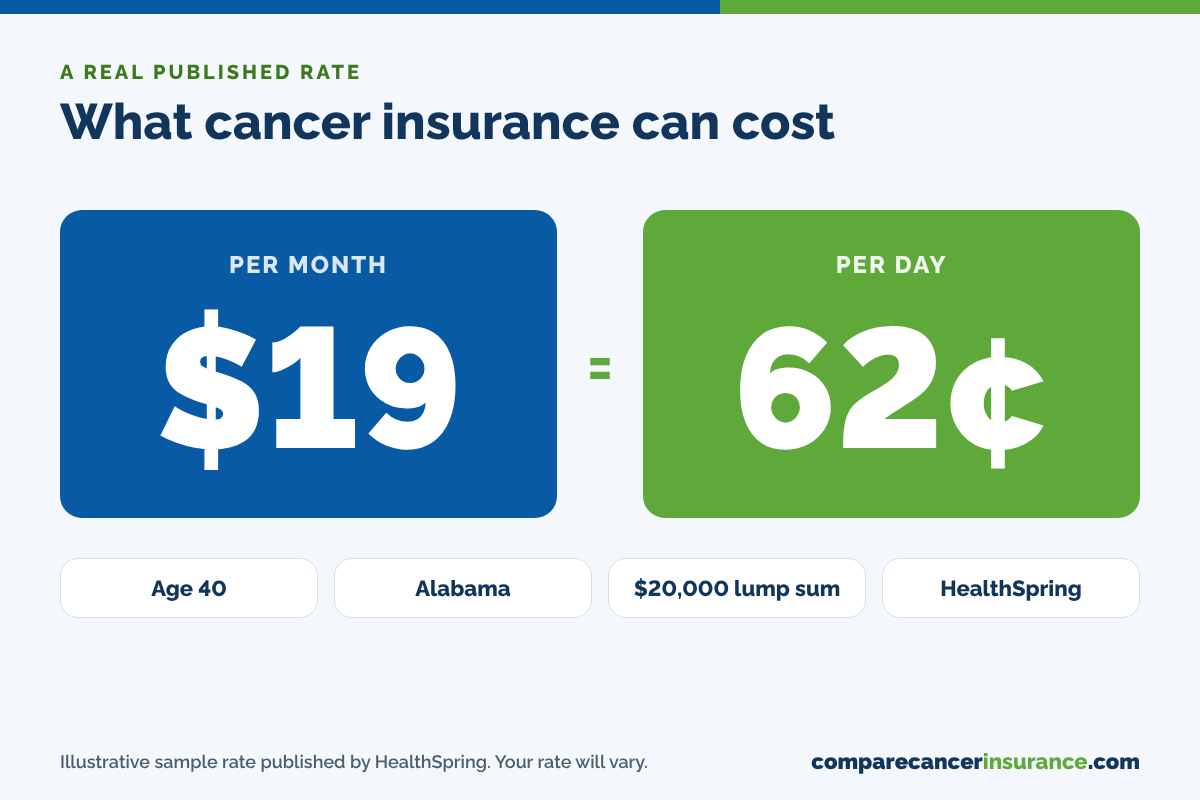
Cancer insurance cost example: HealthSpring sample rate of $19 a month, about 62 cents a day, for a 40-year-old with a $20,000 benefit

What a Cancer Insurance Policy Can Cost

Insurance companies rarely publish full rate charts because prices vary by state and age, but some share sample rates. HealthSpring, for example, lists its lump-sum cancer policy at about $19 a month for a 40-year-old in Alabama choosing a $20,000 benefit. That works out to roughly 62 cents a day.

Your own price will differ. A 30-year-old choosing $10,000 of coverage will usually pay less than that example, while a 65-year-old choosing $50,000 will usually pay much more.

Sample rates are only a starting point

Published examples are illustrations, not quotes. Rates change, and the price you are offered depends on your state, age at issue, coverage type and the benefit amount you select.

What Affects the Cost of Cancer Insurance

Age at issue

The biggest factor. Your premium is based on your age when the policy starts, so buying earlier costs less.

Benefit amount

A $50,000 lump sum costs more than a $10,000 lump sum from the same company.

Who is covered

Adding a spouse or children raises the premium compared with individual coverage.

Your state

Rates, benefit limits and even which policies are sold vary from state to state.

Tobacco use

Many carriers charge tobacco users more than non-users.

Riders

Add-ons such as recurrence, hospital cash or heart attack and stroke coverage each add to the price.

Lump-Sum vs. Scheduled-Benefit Cancer Insurance Cost

Lump-Sum PolicyScheduled-Benefit Policy
How it paysOne cash payment at diagnosisSet amounts for each covered treatment
What sets the priceMainly the lump-sum amount you chooseThe plan level and benefit schedule you choose
Cost predictabilityEasy to compare: same benefit, different priceHarder to compare: total payout depends on treatment
ExampleAetna or HealthSpring lump sums from $5,000Aflac’s Cancer Protection Assurance

Both types can be combined, and some policies include elements of each.

A lump-sum policy makes cost comparisons simple because you can price the same benefit with several carriers. A scheduled-benefit policy may cost more or less depending on the plan level, and its value depends on how much treatment you need.

Individual vs. Employer Cancer Insurance Cost

Individual policy

You buy it yourself and keep it as long as you pay, no matter where you work. You choose the carrier, benefit amount and riders.

Employer group plan

Often lower priced and easier to qualify for during open enrollment, with premiums taken from your paycheck. Coverage may end if you leave the job.

If you already have group coverage at work, an individual policy can add a larger benefit or keep you protected if you change jobs.

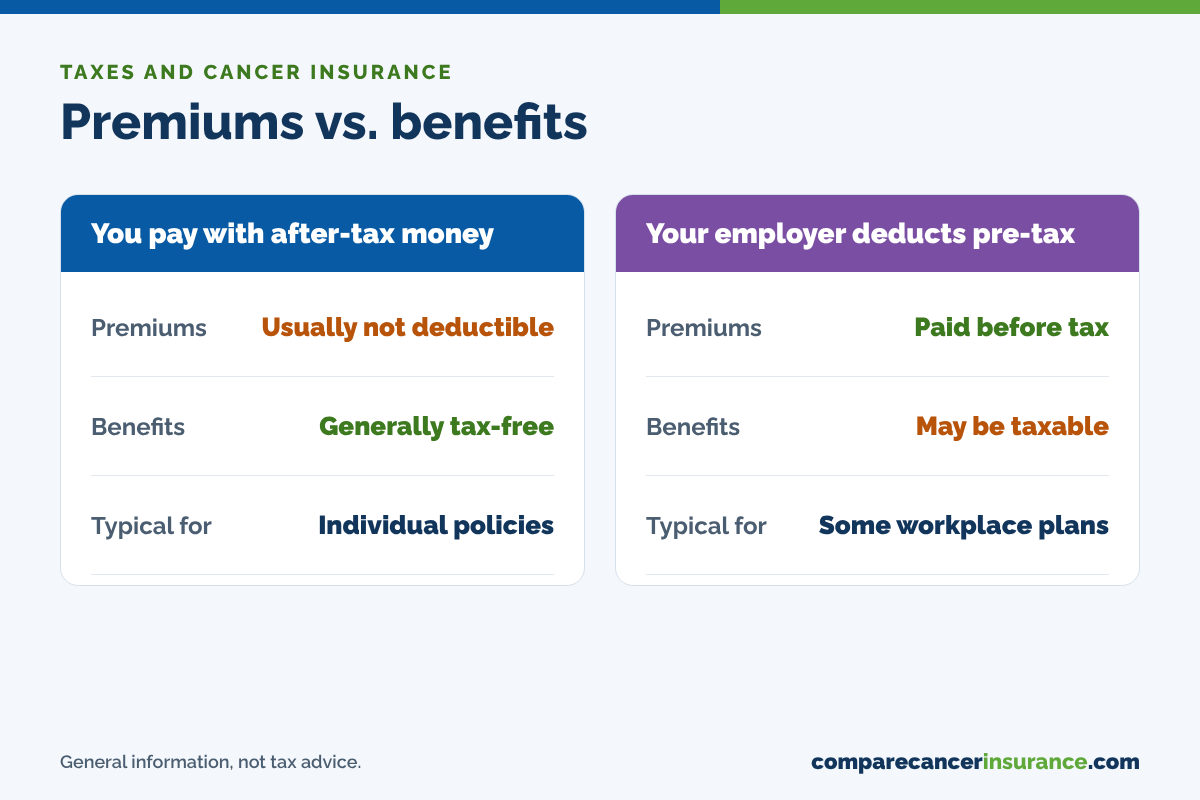
Cancer insurance taxes: after-tax premiums are usually not deductible but benefits are generally tax-free, while pre-tax employer premiums may make benefits taxable

Is Cancer Insurance Tax Deductible?

Premiums for an individual cancer policy are usually not tax deductible. In exchange, benefits are generally tax-free when you pay the premiums with after-tax dollars, so the full check is yours to use.

Employer plans work differently. If your premiums come out of your paycheck before taxes, the benefits you receive may be taxable. Ask your employer or a tax professional how your plan is set up.

How to Lower Your Cancer Insurance Premium

✔Buy while you are younger and healthy to lock in a lower starting rate
✔Choose a benefit amount based on your real out-of-pocket risk, not the maximum available
✔Add only the riders you truly need
✔Price individual and family coverage separately
✔If you use tobacco, ask how quitting could change your rate
✔Compare at least two carriers on the exact same benefit amount

The Bottom Line

The cost of cancer insurance depends on your age, state, benefit amount and riders. Buying earlier and matching the benefit to your real needs keeps the premium low. Compare free cancer insurance quotes from several carriers, and see which companies rank as the best cancer insurance for your situation.

Compare Cancer Insurance Prices

Speak with a licensed insurance agent

1-888-891-0229

Cancer Insurance Cost FAQs

➤ How much does cancer insurance cost per month?

It depends on your age, state, benefit amount and the type of policy. As one published example, HealthSpring lists a lump-sum cancer policy at about $19 a month for a 40-year-old in Alabama with a $20,000 benefit. Older buyers, larger benefits and added riders cost more.

➤ Is cancer insurance expensive?

For many younger and middle-aged adults it is one of the less expensive types of supplemental coverage, often costing about what a streaming subscription or a few coffees cost each month. Premiums rise with age and with the size of the benefit.

➤ Does cancer insurance get more expensive as I age?

Your starting premium is based on your age when the policy is issued, so buying younger usually costs less. Many carriers can also raise rates for an entire group of policyholders, which is why it is worth checking a company’s rate history.

➤ Is cancer insurance tax deductible?

Premiums for an individual cancer policy are usually not tax deductible. The upside is that benefits are generally tax-free when you pay the premiums with after-tax money. Rules for employer plans paid with pre-tax dollars can differ.

➤ Does cancer insurance have a deductible?

Most individual cancer policies do not have a deductible or copay. Once a covered diagnosis is confirmed and any waiting period has passed, the policy pays its stated benefit.

➤ Is cheap cancer insurance worth it?

A low premium can still be good value if the policy pays the way you need. Check the benefit amount, how early-stage cancer is paid, the waiting period and exclusions before choosing the cheapest option.

➤ Is cancer insurance cheaper through work?

Group coverage through an employer can cost less and may be easier to qualify for. It may end when you leave the job, however, and you can only choose the plan your employer offers.

➤ How can I lower the cost of cancer insurance?

Buy while you are younger and healthy, choose a benefit amount that fits your real out-of-pocket risk, skip riders you do not need, avoid tobacco and compare several carriers on the same benefit amount.


Have Questions?

Speak with a licensed insurance agent

1-888-891-0229