Speak with a licensed insurance agent

1-888-891-0229

Critical Illness Insurance: What It Is, What It Covers and If It's Worth It

Updated October 2026

Key Takeaway

Critical illness insurance pays you a lump sum if you are diagnosed with a covered serious illness, such as cancer, a heart attack or a stroke. You decide how to spend the money. It covers more conditions than cancer insurance, while a cancer policy usually goes deeper on cancer itself.

A serious diagnosis brings costs your health plan leaves behind: deductibles, coinsurance, travel to specialists and weeks or months away from work. Critical illness insurance pays cash directly to you so you can cover those costs your way.

This guide covers how critical illness insurance works, the conditions it typically covers, how partial benefits work, what it costs, whether it is worth it and how it compares with cancer insurance. If cancer is your main concern, also see what cancer insurance is.

Compare Critical Illness Insurance Quotes

Speak with a licensed insurance agent

1-888-891-0229

Why critical illness insurance matters: 805,000 heart attacks and 795,000+ strokes in the U.S. each year, plus 2.1 million new cancer cases projected in 2026

What Is Critical Illness Insurance?

Critical illness insurance is a type of supplemental health insurance. It does not replace your health plan, and it does not pay your doctors. Instead, it pays a fixed cash benefit to you when you are diagnosed with one of the serious conditions listed in the policy.

These illnesses are common. The CDC reports that about 805,000 Americans have a heart attack each year and more than 795,000 have a stroke. The American Cancer Society projects about 2,114,850 new cancer cases in the U.S. in 2026. Even with good health insurance, recovering from any of these can bring thousands of dollars in costs that are not covered.

Who gets paid

You, not your doctor or hospital

How it pays

Usually one lump sum per covered condition

How you can use it

Medical bills, rent, groceries, travel or child care

Works with

Employer plans, ACA plans and Medicare

See Critical Illness Insurance Options

Speak with a licensed insurance agent

1-888-891-0229

How Does Critical Illness Insurance Work?

1Choose a benefit amount. Pick a lump sum, such as $25,000 or $50,000, and who you want covered.
2Answer health questions. Individual policies usually ask a short list of questions instead of requiring an exam.
3Pay your premium. Coverage starts on the effective date, though some policies have a waiting period before benefits apply.
4Get diagnosed with a covered condition. The diagnosis must meet the policy’s definition.
5File a claim. Send the claim form and medical records, and the insurer pays the benefit to you.

Before you buy, learn the policy terms that decide when and how much a policy pays:

Waiting period

Time after the policy starts before a diagnosis is covered.

Survival period

Some policies require you to live a set number of days after diagnosis before paying.

Partial benefit

A smaller percentage paid for certain conditions or procedures.

Recurrence benefit

An additional payment if a covered condition returns, on some policies.

Pre-existing condition limit

Conditions treated before coverage may be excluded for a time.

Benefit reduction

Some policies lower the benefit at older ages, so check the schedule.

What Does Critical Illness Insurance Cover?

Every policy has its own list of covered conditions and definitions. These are some of the most commonly covered:

ConditionTypical BenefitWhat to Check
Internal cancer and malignant melanomaFull benefitEarly-stage and skin cancers may pay less or nothing
Heart attackFull benefitHow the policy defines a heart attack
StrokeFull benefitWhether a mini-stroke (TIA) is excluded
Kidney failureFull benefitUsually requires regular dialysis or a transplant
Major organ transplantFull benefitWhich organs are listed
ParalysisFull benefitHow long the paralysis must last
Bypass surgery or angioplastyPartial benefit, such as 25%Whether a later heart attack can still pay
Alzheimer’s disease, blindness, deafnessFull benefit on some policiesNot every policy includes these

Based on common policy designs, including Mutual of Omaha’s critical illness policy. Coverage varies by policy and state.

What is usually not covered

Conditions diagnosed before coverage or during a waiting period, many pre-existing conditions, non-melanoma skin cancers, and illnesses not named in the policy. Less severe versions of a covered condition may pay a reduced amount or nothing.

Critical illness insurance full vs partial benefit on a $50,000 policy: heart attack or stroke pays $50,000, bypass or angioplasty pays $12,500

Full Benefits vs. Partial Benefits

Most critical illness policies pay the full benefit for major diagnoses and a smaller percentage for certain procedures. With Mutual of Omaha’s critical illness policy, for example, a covered heart attack or stroke pays 100% of the benefit, while coronary artery bypass surgery or coronary angioplasty pays 25%.

Example: a $50,000 policy

Covered heart attack (100%)$50,000
Covered stroke (100%)$50,000
Coronary angioplasty (25%)$12,500

A partial benefit gives you cash for a less severe event, but check whether it reduces what is left for a later diagnosis.

Also check whether the policy can pay again for a different condition later. Some pay once and end, while others keep coverage in force for the remaining conditions.

Is Critical Illness Insurance Worth It?

Critical illness insurance is worth it when a serious diagnosis would cause real financial strain. It is a smaller priority when you already have a deep cushion.

It may be worth it if you…

✔Have a high-deductible health plan
✔Have less than a few months of savings
✔Are the main or only earner in your household
✔Have a family history of heart disease, stroke or cancer
✔Are self-employed and cannot bill while sick

It may matter less if you…

✖Have a low out-of-pocket maximum
✖Have six months or more of emergency savings
✖Have generous paid sick leave and disability coverage
✖Have no family history and few risk factors
✖Already have critical illness coverage at work

Decide while you are healthy

Coverage is easiest to get before a diagnosis. Once you have a serious condition, new policies may exclude it or decline you.

How Much Critical Illness Insurance Do You Need?

A practical way to pick a benefit amount is to add up what a serious diagnosis could cost your household in the first year. Here is an example:

CostExample AmountWhere to Find Your Number
Health plan out-of-pocket maximum$8,000Your plan’s summary of benefits
Four months of lost income$16,000Your take-home pay and paid leave
Travel and lodging for treatment$3,000Distance to the nearest specialist
Help at home and child care$3,000Your household routine
Total first-year gap$30,000Your target benefit amount

Example only. Your costs depend on your plan, income, family and location.

In this example, a $30,000 benefit would close the gap. If that premium is too high, a smaller benefit still helps, and you can add coverage later while you are healthy.

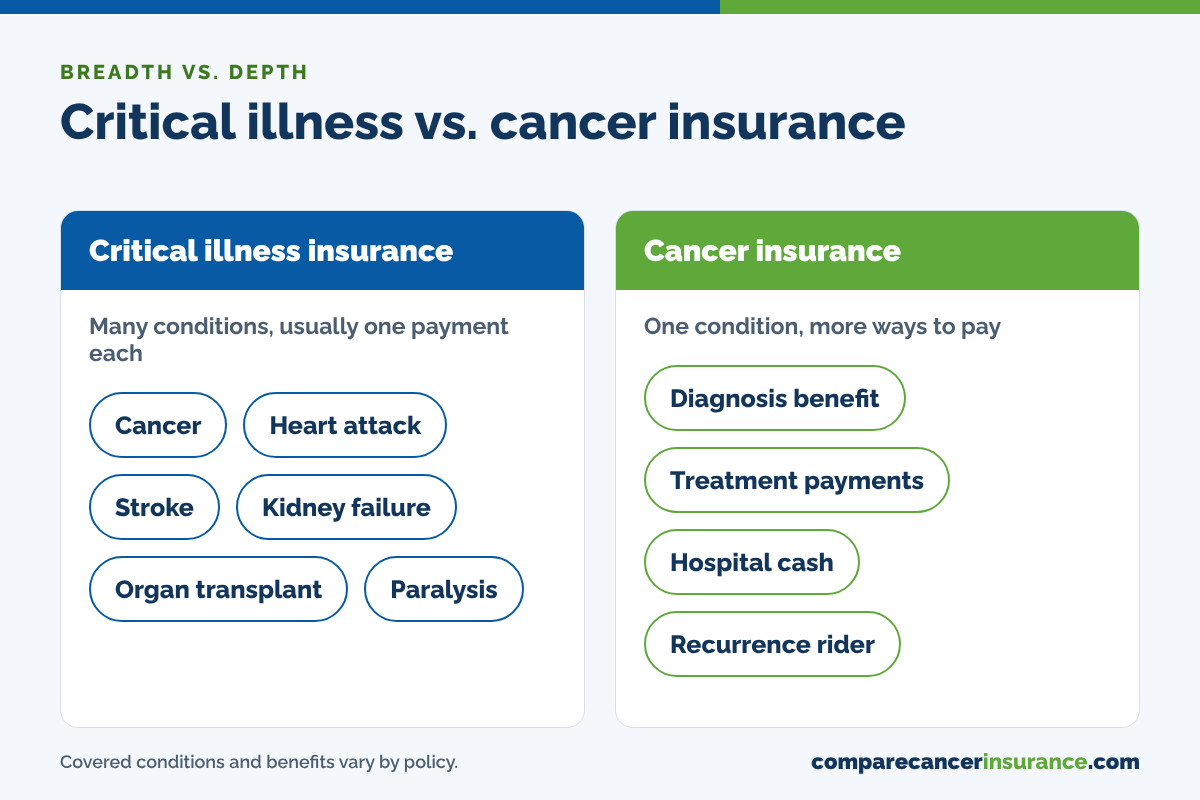
Critical illness vs cancer insurance: critical illness covers many conditions with one payment each, cancer insurance covers cancer with more ways to pay

Critical Illness Insurance vs. Cancer Insurance

Critical Illness InsuranceCancer Insurance
Conditions coveredSeveral, such as cancer, heart attack and strokeCancer only
How it paysUsually one lump sum per covered conditionLump sum, treatment payments or both
Cancer benefitsUsually one diagnosis paymentOften includes treatment, hospital and recurrence benefits
Issue agesOften lower maximum agesSome policies accept applicants into their 90s
Best forBroad protection against several major diagnosesDeeper protection when cancer is the main worry

Features vary by policy and state.

The trade-off is breadth versus depth. A critical illness policy spreads its protection across several diagnoses, while a cancer policy focuses all of its benefits on cancer.

Compare Your Options

Speak with a licensed insurance agent

1-888-891-0229

Critical Illness Insurance vs. Other Coverage

Critical illness insurance fills a specific gap. Here is how it fits with other common types of coverage:

Health insurance

Pays your doctors and hospital. Critical illness cash helps with the deductible and coinsurance it leaves behind.

Disability insurance

Replaces part of your income if you cannot work. Critical illness pays a lump sum soon after diagnosis, often before disability payments start.

Life insurance

Pays your beneficiaries after death. Critical illness pays you while you are living.

Hospital indemnity

Pays per hospital stay for many causes. Critical illness pays per covered diagnosis.

Accident insurance

Pays for accidental injuries. Critical illness covers serious illnesses instead.

Which Should You Choose?

Choose critical illness insurance
You want one policy for several major illnesses, especially if heart disease or stroke runs in your family.
Choose cancer insurance
Cancer is your biggest concern, you want payments during long treatment, or you are older than a critical illness policy’s issue ages allow.
Consider both
You want broad protection plus deeper cancer benefits. Some cancer policies also offer a heart attack and stroke rider as a middle ground.

A licensed agent can price critical illness and cancer coverage side by side so you can compare the cost of each approach.

Individual vs. Employer Critical Illness Insurance

Many people first see critical illness insurance as a voluntary benefit at work. Here is how workplace coverage compares with a policy you own:

Individual policy

You choose the carrier, benefit and riders

Health questions on the application

You pay the insurer directly

Coverage stays with you if you change jobs

Benefits generally tax-free with after-tax premiums

Employer (voluntary) plan

Your employer chooses the plan

Often simplified or guaranteed during open enrollment

Paid through payroll deduction

Coverage may end or need converting if you leave

Benefits may be taxable if paid pre-tax

If your employer offers critical illness coverage, it can be an easy place to start. An individual policy can add a larger benefit or keep you protected if you leave the job.

Critical Illness Insurance Companies We Quote

We quote critical illness and related coverage from several of the carriers we work with:

✔Mutual of Omaha offers a critical illness policy with benefits from $10,000 to $100,000, issue ages 18 to 64, guaranteed renewable coverage and a return of premium benefit at death.
✔HealthSpring offers a heart attack and stroke rider on its cancer treatment policy.
✔Aetna and MetLife offer critical illness plans through many employers.

For cancer-only coverage, see our ranking of the best cancer insurance companies.

Get Critical Illness Insurance Quotes

Speak with a licensed insurance agent

1-888-891-0229

How Much Does Critical Illness Insurance Cost?

Your premium is set mostly by these factors:

Your
age
Benefit
amount
Tobacco
use
Who is
covered

Riders and your state also affect the price. Because a critical illness policy covers more conditions, it often costs more than a cancer-only policy with the same benefit amount.

The best way to know your price is to compare quotes on the same benefit amount. Our guide to cancer insurance cost explains the pricing factors that apply to both types of coverage.

How to File a Critical Illness Claim

1Call the insurer or your agent soon after diagnosis to start the claim.
2Complete the claim form with your policy number and diagnosis details.
3Send medical records, such as a pathology report, test results or your doctor’s statement.
4Receive your benefit once the insurer confirms the diagnosis meets the policy definition.

Sending complete records the first time is the best way to avoid delays.

The Bottom Line

Critical illness insurance gives you a lump sum when a serious diagnosis hits, on top of the coverage you already have. Check how each policy defines covered conditions and partial benefits, size the benefit to your real first-year gap, and get free quotes for critical illness and cancer coverage while you are healthy enough to qualify.

Compare Critical Illness Insurance

Speak with a licensed insurance agent

1-888-891-0229

Critical Illness Insurance FAQs

➤ What is critical illness insurance?

Critical illness insurance is a supplemental policy that pays a lump-sum cash benefit if you are diagnosed with a covered serious illness, such as cancer, a heart attack or a stroke. The money is paid directly to you and can be used for anything, from medical bills to rent.

➤ What does critical illness insurance cover?

Covered conditions vary by policy. Many include internal cancer, heart attack, stroke, kidney failure, major organ transplant and paralysis, and some add Alzheimer’s disease, blindness and deafness. Some procedures, like coronary angioplasty, pay a partial benefit.

➤ Is critical illness insurance worth it?

It can be worth it if a serious diagnosis would strain your finances, such as when you have a high-deductible health plan, limited savings, a single household income or a family history of heart disease or cancer. It matters less if you have large savings and generous paid leave.

➤ How does critical illness insurance work?

You choose a benefit amount and pay a monthly premium. If you are diagnosed with a covered condition after any waiting period, you file a claim with your medical records, and the insurer pays the benefit to you in one lump sum.

➤ How much does critical illness insurance cost?

Premiums depend on your age, benefit amount, tobacco use, who is covered and your state. Younger applicants and smaller benefits cost less. Because it covers several conditions, critical illness insurance often costs more than a cancer-only policy with the same benefit.

➤ Is critical illness insurance the same as cancer insurance?

No. Critical illness insurance covers several serious conditions, including cancer. Cancer insurance covers only cancer, but often pays more types of cancer benefits, such as treatment payments, hospital cash and recurrence coverage.

➤ What is voluntary critical illness insurance?

Voluntary critical illness insurance is coverage offered through an employer that employees choose to buy, usually through payroll deduction. The employer selects the plan, and coverage may end if you leave the job unless it can be continued.

➤ Does critical illness insurance cover pre-existing conditions?

Usually not right away. Many policies exclude or limit conditions you were diagnosed with or treated for before coverage began, often for a set period. Individual policies also ask health questions that can affect whether you qualify.

➤ Are critical illness insurance benefits taxable?

When you pay the premiums with after-tax money, as with most individual policies, benefits are generally not taxable. If an employer plan is paid with pre-tax dollars, benefits may be taxable. Ask a tax professional about your situation.

➤ Can critical illness insurance pay more than once?

Some policies can. Many pay for a different covered condition later, and some offer a recurrence or second-occurrence benefit for the same condition after a set time. Others end after the first full payment, so check the policy terms.


Have Questions?

Speak with a licensed insurance agent

1-888-891-0229